
Research Trip to Solingen, Day Two: Inside the Deutsches Klingenmuseum

Updated: Sep 2

After spending Day One at the Solingen City Archive (Stadtarchiv Solingen), working through old catalogs, records and other material, Day Two was the opposite: I finally got to see the knives themselves.
I spent the day at the Deutsches Klingenmuseum, where the history I had been reading about was sitting right in front of me in the display cases.
Regular adult admission was €8, and for anyone interested in traditional knives or Solingen history, there is a lot to see. The collection goes well beyond pocket knives, with swords, razors, scissors, table cutlery, work knives and specialized cutting tools all part of the larger story of the City of Blades.
A wall of blade history

One of the first displays that stopped me was the huge yellow wall filled with blades and tools. Seeing everything together gives you an immediate sense of how broad Solingen's cutting industry really was. It is not just knives. The variety of shapes, sizes and specialized tools is almost overwhelming when you see them all in one place.
The pocket knife cases were the main event for me

Naturally, this is where I slowed down. I kept finding myself studying the construction more than the decoration: springs, liners, pins, bolsters, the arrangement of the tools and the way everything had been fitted into the frame. Those are exactly the details I tend to look for when trying to understand an old knife.
Some of the folding knives are straightforward working pieces, while others are miniature demonstrations of what a cutler could build when simplicity was not the goal. The elaborate multi-blade examples are especially impressive. Seeing them in person makes it much easier to understand how much engineering went into fitting so many blades and tools into a relatively small knife.
It also reinforces something that gets lost when we reduce traditional knives to a few familiar patterns. Solingen makers produced an enormous range of folding knives: work knives, gentleman's knives, utility patterns, advertising knives and highly finished showpieces.
Razors and another side of Solingen

The razor displays were another section I spent time with. Straight razors are such a strong part of Solingen's international reputation, and the cases make the changes in construction and handle materials easy to see. Wood, horn, bone, metal and more decorative materials all appear, from simple working razors to pieces that were clearly made to impress.
The 154-blade giant pocket knife

Then there is the piece that is almost impossible to miss: the museum's famous giant pocket knife with 154 blades. Made by Herbert Kullenberg of Solingen between 1926 and 1938, it is an extraordinary display piece, with blades and tools radiating in every direction and the Solingen coat of arms prominently displayed on the handle.
Fitting 154 individual blades and tools into a single piece demonstrates the skill and technical range of Solingen's cutlers.
The details are what stayed with me
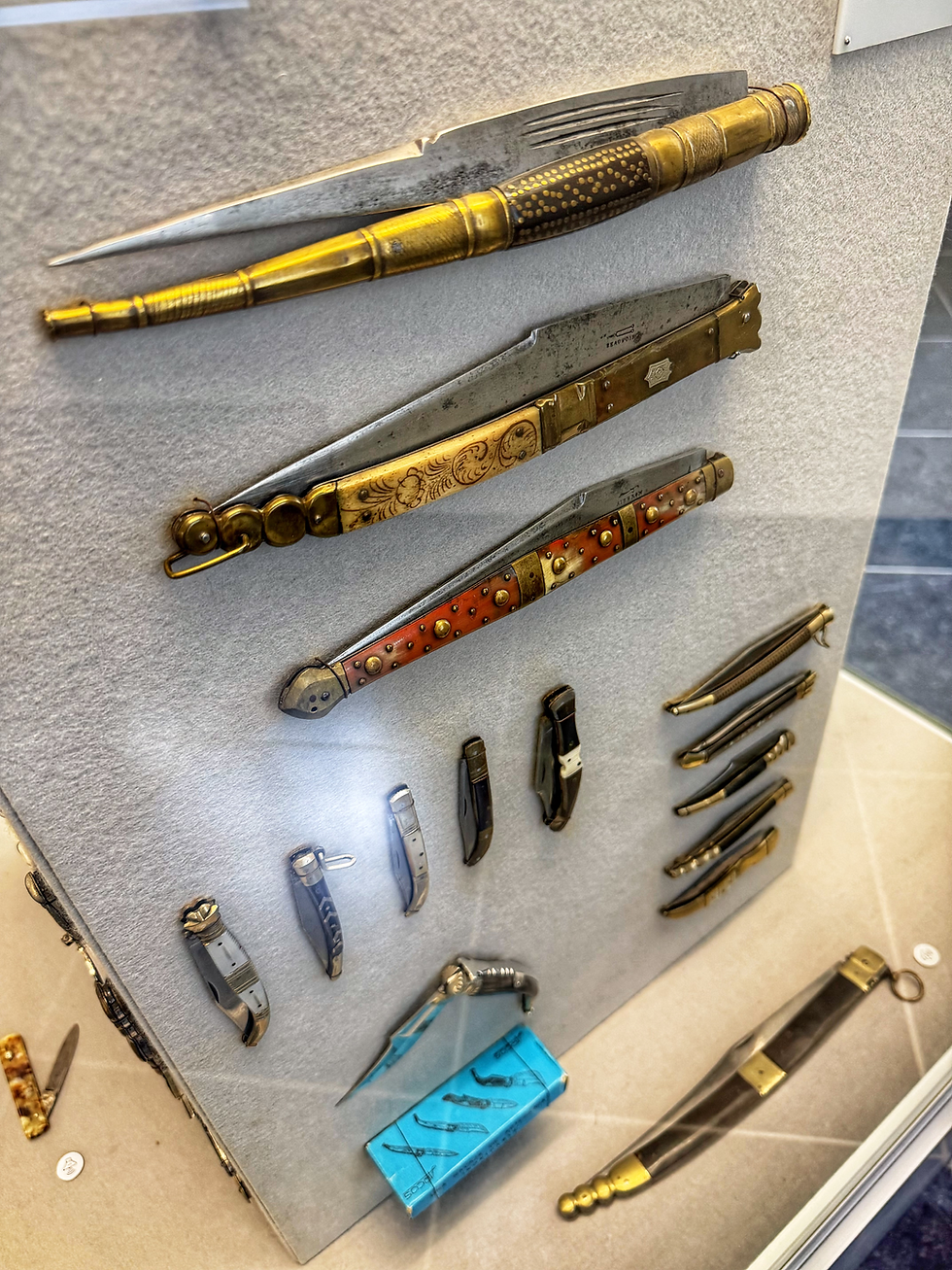
The longer I spent in the museum, the more I found myself focusing on small construction details: old pins and bolsters, unusual handle shapes, long slender frames, decorative brass work and the way different materials were fitted together. Those details are often more useful to me than simply looking at the overall shape of a knife.
That is probably the greatest value of seeing original examples in person. A pattern that seems unusual when you find one knife at a flea market or online starts to make more sense when you can compare it with other period pieces. After seeing enough of them together, certain construction methods and design choices begin to stand out much more clearly.
Next: into the Klingenmuseum archive
Day Two was about walking through that history and seeing the physical objects themselves. The next morning I came back, but this time I was not there for the exhibits. I was headed into the Klingenmuseum archive, where catalogs, pattern books and primary sources started answering the questions that brought me to Solingen — especially the early history of German Sportmesser-style utility knives and rivet knives. That archive work deserves its own post. That will be Day Three.


Comments