
Research Trip to Solingen, Day One: Inside the Solingen City Archive

Updated: Sep 3

The Journey North
I traveled from Munich to Solingen, Germany—the city long known as the “City of Blades”—to spend three days researching two longstanding questions that had been driving my work.
The first was to determine just how old the Sportmesser really is. Böker has long stated that it has manufactured the Sportmesser continuously since 1869, but I wanted to see what historical documentation could actually be found to establish the history of this iconic knife design.
The earliest documented examples I’ve found so far come from Böker source materials dating to 1930. One of my goals for this trip was to see if that date could be pushed back further by uncovering evidence of earlier Sportmesser examples from any German manufacturer.
My research wasn’t necessarily focused on finding an early Böker example—although that certainly would have been exciting. Any German-made Sportmesser dating to the early 1900s, or ideally before 1920, would have been an important discovery and would help establish that the Sportmesser pattern was already in use during that period.
My second research objective was to learn more about traditional German rivet knives. Despite their popularity among collectors and their long association with Solingen, surprisingly little information exists about their origins, who made them, and how their designs evolved over time.
In many ways, this trip felt like chasing two separate mysteries at once.
Wednesday would be spent at the Solingen City Archive, Thursday at the Deutsches Klingenmuseum, and Friday in the Deutsches Klingenmuseum archive.
Day One: Solingen City Archive
Wednesday morning began with my first appointment at the Solingen City Archive.
Before the trip, I had already spent time researching available materials online and pre-ordering documents that I thought might be relevant to my project.
Walking into the archive and seeing the materials waiting for me was exciting. There’s something different about working with original historical documents—turning pages that few people have examined in decades and never quite knowing what you might discover next.
In addition to the materials I had requested in advance, the archive staff pointed me toward several additional sources that proved useful for my research.
Research Track One: Tracing the Sportmesser
I located two important Böker sources.
The first was Special Price List No. 2, dated 1930. The second was Special Catalog No. 3. While there is no visible date anywhere on the catalog itself, it was in the same folder as the 1930 Special Price List No. 2. Based on that context, I suspect the catalog also dates to the early 1930s, although I can’t say that with certainty.

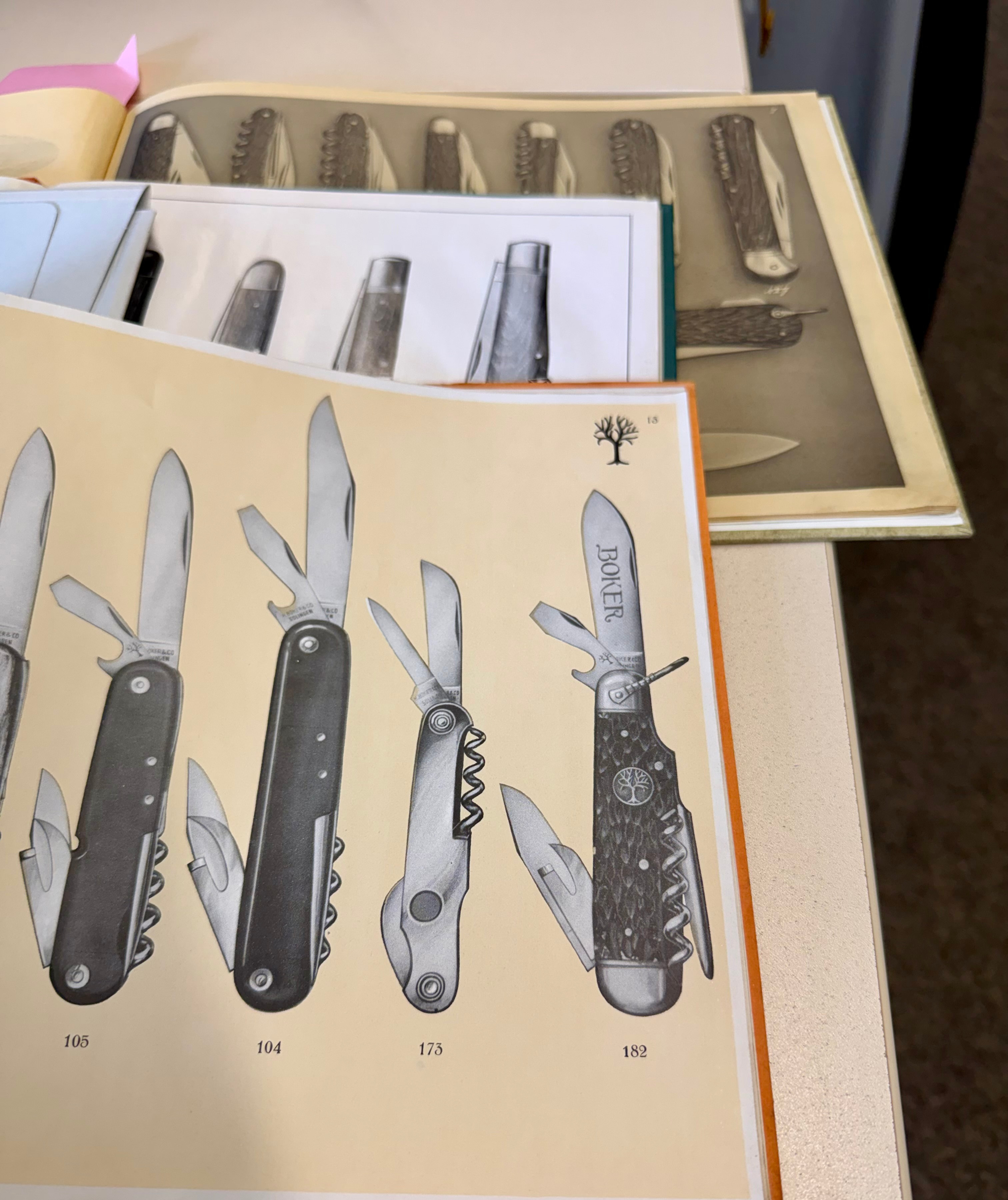
One of the earliest documented Sportmesser references I’ve found so far.
One detail immediately caught my attention. The black-and-white photograph from Special Price List No. 2 shows a wonderfully long bail—something I’ve never encountered on an actual surviving example. It was one of those small details that made examining the original materials worthwhile.
At least for now, I still haven’t found any references to the Sportmesser before 1930—not from Böker and not from any other manufacturer, for that matter. But the hunt continues.
I also examined Böker catalogs from 1989, 1990, and 1994, all of which contained examples of the Sportmesser, demonstrating the remarkable longevity of the design.
For now, 1930 remains the earliest documented reference I’ve found.
Research Track Two: Tracing the German Rivet Knife
The second half of my research focused on German rivet knives, and I was pleased to uncover a substantial amount of information.
One of the reasons for making this trip was that there simply isn’t a lot of consolidated information available about German rivet knives. There is no definitive history explaining how old these knives are, who originally made them, or how their designs evolved over time.
Building a timeline for the German rivet knife.
I was able to examine several important sources that helped begin building a timeline.


These sources provided valuable insight into the variety of rivet knife patterns being produced in Solingen and helped begin to answer some of the many questions surrounding their history.
Considering how iconic these knives have become, I was surprised by how many unanswered questions still remain.
Looking Ahead
This is only the first day of a three-day research trip.
Next up: the Deutsches Klingenmuseum.


Comments